Customer accounts
Create new customers or update existing accounts from your own systems.

 XML API FOR SAGE 200
Connect business applications, web stores and cloud services with XML.
Let PostTrans take care of the import.
Standalone Windows application · Try with Sage demonstration data
 PostTrans XML APIReceive · Validate · ImportSage 200Records · Transactions
A SIMPLE CONNECTION
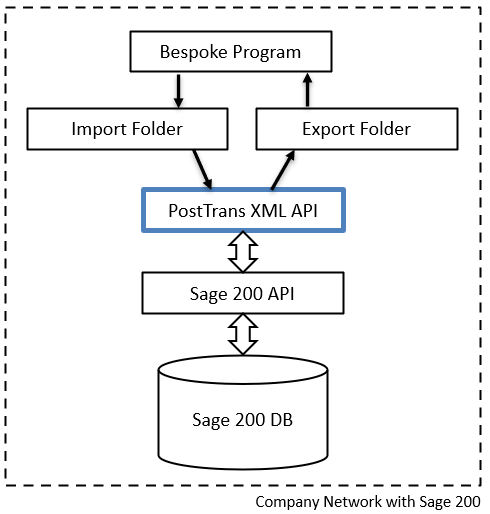
Prepare an XML file for each transaction in your business application or web store. Start with the examples below and follow the field mappings for your import.
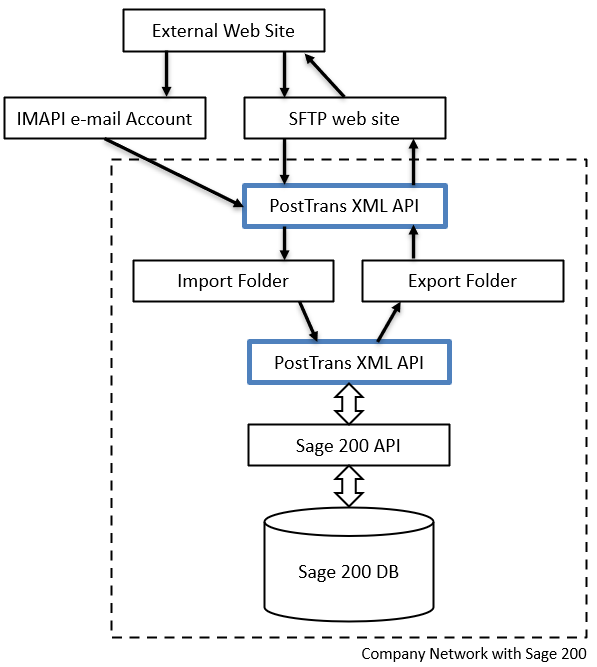
Send files to a designated folder, a remote SFTP location or a supported email account. Email can contain XML in the plain-text message or as attachments.
Read the setup and delivery guide ↗Run imports automatically or at the press of a button. The PostTrans engine and Sage 200 API validate the data as it is processed.
KEEP CONTROL WHEN SOMETHING NEEDS ATTENTION
If a file fails PostTrans or Sage 200 API validation, it moves to the failed directory with the reason added to the XML. An email alerts your nominated user.
Correct the file and move it back to the import folder to submit it again. You can also configure an email alert if the software has not been running for 30 minutes.
Read the user guide ↗START WITH AN EXAMPLE
Open an example to see the XML structure and fields for your import.
Follow the demonstration videos and user guide to set up your first integration.
All demonstration videos ↗Setup and user guide ↗XML settings and mappings ↗Evaluate with Sage demonstration data, then choose a subscription for live use. Subscriptions can be cancelled online, with annual payment on account also available.
Download and install ↗Compare XML API plans ↗